
 Hassan malik

Introduction
Individual investors, professional traders, financial institutions, and Bitcoin Latest News blockchain enthusiasts are all paying attention to Bitcoin because it continues to play a significant role in the global cryptocurrency market. The concept of digital money, online payments, and alternative financial systems has been fundamentally altered by Bitcoin, the world’s first decentralized cryptocurrency. Its limited supply, decentralized structure, and growing institutional interest make it one of the most closely followed digital assets in the world.
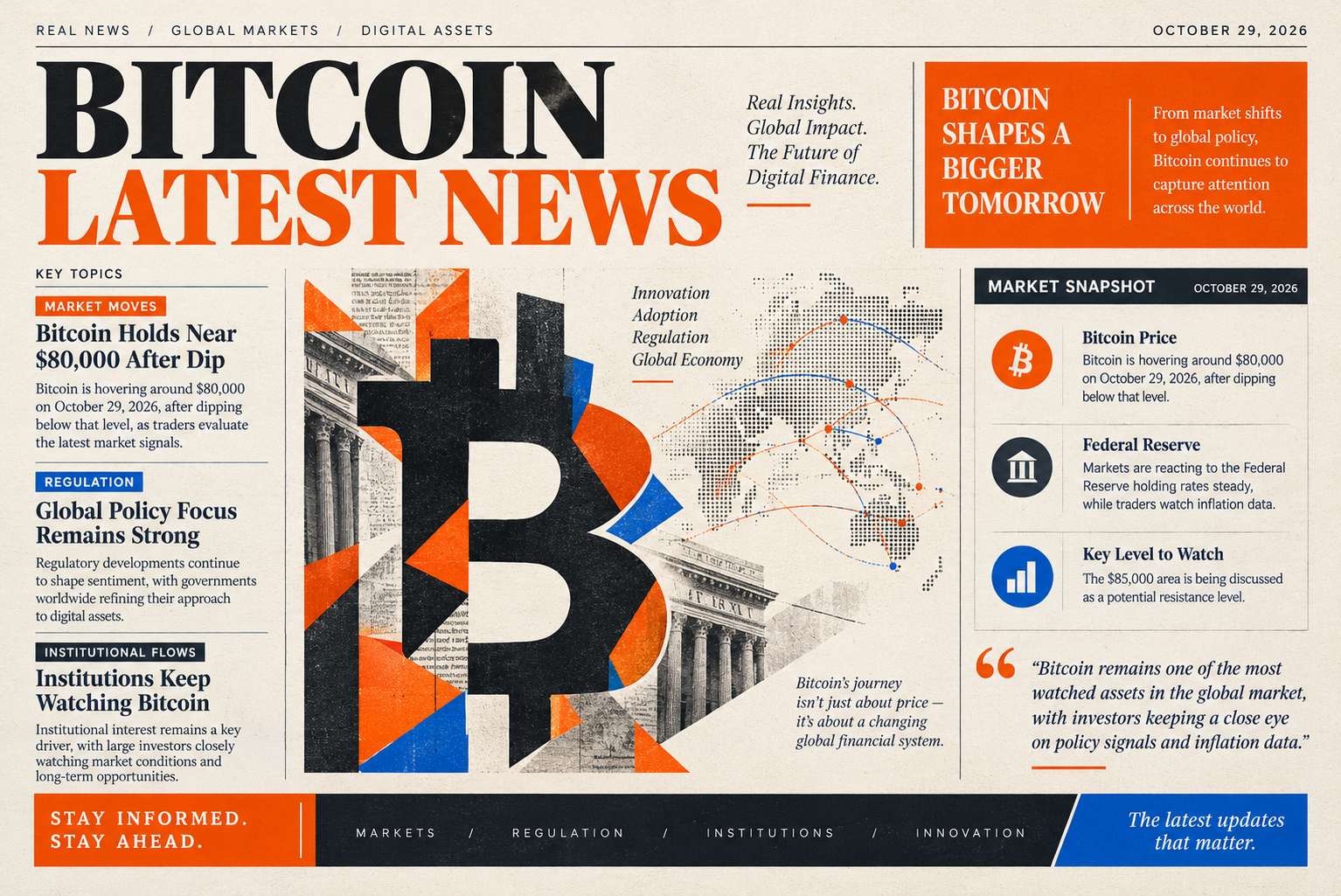
The Bitcoin latest news remains an important topic for anyone interested in understanding the changing cryptocurrency market. Market sentiment is affected on a daily basis by changes in Bitcoin prices, institutional investments, exchange-traded funds, government regulations, blockchain technology, and global economic conditions. Investors may face risks as well as new opportunities as a result of these developments. Bitcoin is gaining attention in 2026 for a number of reasons, including the expansion of regulated investment products, changes in cryptocurrency regulation, and shifting institutional investment strategies.
Both Switzerland’s approval of a new retail Bitcoin investment fund and the ongoing interest in Bitcoin exchange-traded funds have been highlighted in recent reports. However, in order to comprehend Bitcoin, one must do more than simply examine its current price. Trading volume, market capitalization, economic conditions, investor sentiment, and adoption over the long term must all be taken into account by investors. The most recent Bitcoin news, significant market developments, price fluctuations, institutional adoption, and possible future trends are all examined in this article. Understanding the Current Bitcoin Market.
The Bitcoin market operates differently from traditional financial markets. Bitcoin is traded globally through cryptocurrency exchanges, and its price changes according to supply, demand, investor expectations, and broader economic developments. Unlike traditional currencies, Bitcoin has a maximum supply of 21 million coins. This limited supply is one of its most recognized characteristics and contributes to its reputation as a scarce digital asset.
Why Bitcoin Remains Important in 2026
Bitcoin continues to dominate discussions about digital assets because of its established network, global recognition, and relatively long operating history. Many investors consider it an important part of the cryptocurrency ecosystem. Its decentralized network allows transactions to take place without depending on a single central authority. This structure gives Bitcoin a different financial model compared with conventional banking systems.
Another important factor is its growing relationship with traditional finance. Investment companies, financial institutions, and asset managers are increasingly exploring ways to provide customers with regulated exposure to Bitcoin. The Bitcoin latest news therefore involves more than cryptocurrency trading. It also reflects changes in global finance, investment products, technology, and financial regulation.
Bitcoin Market Sentiment and Investor Confidence
Market sentiment describes how investors feel about Bitcoin’s future direction. Positive sentiment can encourage buying activity, while negative sentiment can lead to selling pressure. Several factors influence Bitcoin market sentiment, including economic announcements, institutional investments, regulatory decisions, exchange activity, and technical indicators. When investors expect stronger demand, they may become more willing to purchase BTC. However, uncertainty surrounding interest rates, inflation, or international financial conditions can reduce demand for risky assets. Understanding sentiment helps investors interpret market movements instead of making decisions based entirely on short-term price changes.
Latest Bitcoin News and Major Developments in October 2026

October 2026 has brought several important developments for Bitcoin and the wider cryptocurrency industry. Institutional investment, regulated financial products, market volatility, and corporate Bitcoin strategies are among the major themes attracting attention.
Switzerland Approves Its First Retail Bitcoin ETF
One of the important developments in recent Bitcoin news is Switzerland’s approval of its first spot Bitcoin exchange-traded fund designed for retail investors. According to an October 20 report by The Block, Switzerland’s financial regulator, FINMA, approved the Bitcoin Fund ETF from BIT Asset Management. The fund, identified as BBIT, is expected to begin trading on the SIX Swiss Exchange in November 2026. This development is significant because the fund is designed to hold Bitcoin directly rather than simply tracking cryptocurrency-related companies.
It also operates under Swiss fund regulations, which include requirements concerning asset custody, operational risks, and investor disclosures. The approval demonstrates how traditional financial markets are developing additional ways for investors to access Bitcoin. However, an exchange-traded fund does not remove Bitcoin’s market risks. Its value can still decline when the underlying cryptocurrency loses value.
Bitcoin ETF Investment Flows Remain Important
Bitcoin ETFs have become an important part of the cryptocurrency investment landscape. These financial products allow investors to gain exposure to Bitcoin through regulated investment accounts without personally managing cryptocurrency wallets. Recent market reporting covering October 19–23 showed that US spot Bitcoin ETFs recorded approximately $301 million in net weekly inflows. However, this positive weekly result followed significant withdrawals during the final trading sessions of that period.
The same report highlighted approximately $665.2 million in inflows into BlackRock’s IBIT fund on October 19. These figures demonstrate that institutional demand can remain active even when daily investment flows fluctuate. Investors following the Bitcoin latest news should monitor ETF flows over several weeks instead of treating one positive or negative trading session as proof of a long-term market direction.
Strategy Continues Its Bitcoin Treasury Approach
Corporate Bitcoin adoption is another important subject in cryptocurrency news. Some companies purchase Bitcoin as part of their treasury strategies, seeking exposure to a scarce digital asset rather than keeping all their reserves in traditional currencies. Strategy remains one of the most closely followed examples of this approach. Its Bitcoin accumulation strategy has attracted attention from investors who want to understand the relationship between corporate financing, share prices, and cryptocurrency ownership. An October 26 market roundup reported that Strategy added approximately $22 million in Bitcoin while repurchasing around $193 million of its preferred stock. Corporate purchases can strengthen market interest, but they do not guarantee a Bitcoin rally. Investors should examine company financing, debt obligations, share dilution, and the risks associated with holding a volatile asset on a corporate balance sheet.
Bitcoin Price Analysis and Market Trends
The Bitcoin price is one of the most important subjects for cryptocurrency investors. BTC trades continuously across global exchanges, meaning its price can change at any hour. Bitcoin price movements are influenced by buying and selling pressure, institutional activity, economic developments, market liquidity, and investor expectations.
Bitcoin Price Movements
Bitcoin’s price does not move in a straight line. It regularly experiences rallies, corrections, consolidation periods, and sudden changes in momentum. A rally occurs when buying pressure becomes stronger and buyers are willing to purchase Bitcoin at increasingly higher prices. A correction happens when the market moves lower after a previous increase. Consolidation describes a period when Bitcoin trades within a relatively limited price range. During this stage, buyers and sellers may be waiting for a major economic announcement, regulatory decision, or market catalyst. Understanding these conditions helps traders interpret BTC price movements more carefully. For example, a short-term increase in Bitcoin’s value does not automatically indicate the beginning of a new bull market. Investors should also examine trading volume, support levels, resistance levels, and broader market conditions.
Bitcoin Support and Resistance Levels
Support and resistance are important concepts in technical analysis. Support refers to a price area where buying interest may increase and prevent the market from falling further. Resistance describes an area where selling pressure may become stronger. Traders use these levels to understand possible market reactions. If Bitcoin repeatedly holds a support area, investors may interpret that behavior as evidence of buying interest. However, if Bitcoin falls below an important support level with strong trading volume, it could indicate additional selling pressure. Resistance levels work in the opposite direction. When Bitcoin approaches a resistance area, some traders may take profits, creating additional selling activity. A confirmed move above resistance can attract attention from momentum traders, although a breakout can also fail and return below the previous level.
Bitcoin Trading Volume and Market Liquidity
Trading volume measures how much Bitcoin is bought and sold during a specific period. It helps investors understand the strength behind a price movement. A price increase accompanied by stronger trading volume may indicate that more market participants are supporting the upward movement. On the other hand, a price increase with weak volume may require additional confirmation. Market liquidity is equally important. It refers to how easily investors can buy or sell Bitcoin without significantly changing its market price.Higher liquidity generally makes it easier for large transactions to take place. Lower liquidity can increase price volatility, particularly during periods of uncertainty. Investors should consider both indicators when evaluating Bitcoin market conditions. Institutional Adoption and Bitcoin Investment Institutional adoption has become one of the most important long-term developments in the cryptocurrency industry. Financial institutions, investment managers, publicly traded companies, and other professional investors are exploring Bitcoin as an alternative digital asset.
Why Financial Institutions Are Interested in Bitcoin
Traditional financial institutions are interested in Bitcoin because it offers exposure to a different type of asset. Its decentralized network and limited supply distinguish it from traditional currencies and many conventional investments. Some institutions view Bitcoin as a potential long-term store of value. Others are interested in providing investment products that allow customers to access the cryptocurrency market through familiar financial systems. The development of spot Bitcoin ETFs has made this process more accessible in certain jurisdictions.
Institutional participation can also improve market infrastructure by encouraging stronger custody solutions, professional trading services, and improved compliance procedures. However, institutional investment should not be interpreted as a guarantee of rising prices. Large investors can reduce their exposure just as quickly as they increase it, depending on economic conditions and investment strategies.
Corporate Bitcoin Holdings
Some businesses have added Bitcoin to their corporate balance sheets. These companies may believe that Bitcoin offers long-term value because of its limited supply and global accessibility. Corporate adoption can influence market sentiment, particularly when a well-known company announces a significant purchase. Nevertheless, holding Bitcoin introduces financial risks. A major decline in cryptocurrency prices can reduce the value of corporate reserves and affect investor confidence.
Businesses must also consider accounting rules, taxation, liquidity requirements, and regulatory obligations. For this reason, corporate Bitcoin adoption should be evaluated through actual financial disclosures rather than social media announcements or market speculation.
Bitcoin Adoption in Traditional Finance
Bitcoin’s relationship with traditional finance continues to evolve. Banks, asset managers, payment providers, and financial technology companies are exploring digital asset services. This includes cryptocurrency custody, trading infrastructure, investment products, and blockchain-based settlement systems. As regulated financial products become more widely available, investors may find it easier to access Bitcoin without directly interacting with cryptocurrency exchanges. The long-term impact will depend on customer demand, regulatory approval, product costs, security standards, and the ability of financial institutions to manage cryptocurrency-related risks. Bitcoin Regulation and Government Policies Government regulation is another major factor influencing Bitcoin’s future. Cryptocurrency rules can affect exchanges, financial institutions, investment funds, businesses, and individual investors.
How Government Regulations Affect Bitcoin
Cryptocurrency regulation determines how digital assets can be traded, stored, marketed, and used within different countries. Clear regulations can help financial institutions understand their legal responsibilities. They can also establish requirements for customer protection, anti-money laundering procedures, financial reporting, and asset custody. However, unclear or restrictive rules may create uncertainty for cryptocurrency businesses and investors. Different countries have adopted different approaches to Bitcoin. Some support regulated cryptocurrency services, while others impose restrictions on particular activities. Investors should therefore understand the laws that apply in their own jurisdictions before purchasing or trading digital assets.
US Cryptocurrency Regulatory Developments
The United States remains an influential market for Bitcoin because of its financial institutions, investment companies, cryptocurrency exchanges, and regulatory authorities. In October 2026, Reuters reported that the US Securities and Exchange Commission proposed new rules concerning investment advisers’ custody of crypto assets under federal securities laws. The proposal aims to establish a clearer framework for how investment funds and advisers handle digital assets. Regulatory developments of this kind can influence institutional participation because professional investors generally require reliable custody arrangements and clear compliance responsibilities. However, a proposed rule should not be confused with a finalized regulation. Investors should follow official announcements and implementation details before drawing conclusions about its impact.
Why Regulatory Clarity Matters for Investors
Regulatory clarity can increase confidence among businesses and professional investors. When companies understand the rules governing cryptocurrency transactions, they may find it easier to develop compliant products and services. It can also help consumers identify legitimate platforms and understand the risks associated with digital asset ownership. Nevertheless, regulation cannot eliminate cryptocurrency volatility, hacking risks, market manipulation, or investment losses. The Bitcoin latest news surrounding government policies should therefore be evaluated alongside actual market developments and official regulatory announcements.
Bitcoin Technology and Blockchain Developments
Bitcoin is more than a digital currency. It operates through a decentralized blockchain network that records transactions and maintains a shared transaction history.
How Bitcoin Blockchain Technology Works
The Bitcoin blockchain is a distributed digital ledger maintained by computers participating in the network. Transactions are grouped into blocks, which are connected through cryptographic methods. This creates a historical record that is difficult to change without substantial computational effort. Bitcoin uses a proof-of-work consensus mechanism. Miners compete to solve computational problems and propose new blocks for inclusion in the blockchain. Successful miners receive block rewards and transaction fees according to the network’s rules. This system helps protect the network against unauthorized changes and allows participants to verify transactions without relying on a central bank or single organization.
Bitcoin Mining and Network Security
Bitcoin mining is an essential part of the network’s security model. Miners use specialized computer hardware to perform calculations and compete for the opportunity to add new blocks. Mining requires electricity, equipment, maintenance, and technical knowledge. Its profitability depends on several factors, including Bitcoin’s market price, mining difficulty, electricity costs, and hardware efficiency. As mining competition changes, the network adjusts its mining difficulty to maintain an average block production time of approximately ten minutes. Bitcoin’s decentralized mining structure contributes to network security, although mining concentration, energy consumption, and environmental concerns remain important industry discussions.
Bitcoin Core and Network Development
Bitcoin’s software is maintained through an open-source development process. Developers review proposed changes, identify vulnerabilities, and work to improve the reliability of the network. An October 2026 industry roundup reported that Bitcoin Core developers had revised vulnerability disclosure policies in response to the growing ability of AI tools to identify software weaknesses. This development concerns security disclosure practices rather than a new Bitcoin consensus upgrade. Security improvements are important because Bitcoin depends on reliable software, independent verification, and responsible coordination among developers.
Important Factors That Could Influence Bitcoin’s Future

Bitcoin’s future performance will depend on several interconnected factors. Although historical price movements can provide useful information, future market conditions are never guaranteed. Federal Reserve Interest Rates and Inflation. The Federal Reserve’s monetary policy can influence Bitcoin because cryptocurrency markets are connected to broader financial conditions. When interest rates rise, investors may prefer traditional financial products that offer more attractive returns.
This can reduce demand for riskier assets, including Bitcoin. When interest rates decline, borrowing conditions may become easier, and some investors may become more interested in alternative investments. Inflation is another important factor. Some investors consider Bitcoin an alternative asset because its maximum supply is limited to 21 million coins. However, Bitcoin does not always perform like a traditional inflation hedge. Its price can decline even when inflation remains high. Investors should monitor inflation reports, interest-rate announcements, employment statistics, and central bank statements to understand the economic environment surrounding Bitcoin.
Global Economic Conditions
International economic developments can create opportunities and challenges for Bitcoin. Financial uncertainty, geopolitical tensions, currency fluctuations, and changes in global liquidity can influence investor decisions. During periods of uncertainty, some investors may increase their interest in decentralized assets. Others may sell cryptocurrency holdings to reduce exposure to volatile investments. This means Bitcoin can respond differently to similar economic events depending on market sentiment and existing investment positions. Understanding the global economy is therefore an important part of following Bitcoin market news.
Bitcoin Supply and Demand
Bitcoin’s limited supply is one of its most important characteristics. Unlike traditional currencies, which can be issued according to monetary policy, Bitcoin follows a predetermined issuance schedule. The network’s halving mechanism reduces the block reward approximately every four years. The most recent halving occurred in April 2024, reducing the mining reward from 6.25 BTC to 3.125 BTC. This reduction slows the creation of new Bitcoin. However, lower issuance does not automatically cause prices to rise. Actual price movements depend on demand, existing market supply, investor expectations, liquidity, and economic conditions. When demand increases while available selling supply remains limited, upward price pressure may develop. If demand weakens, Bitcoin can experience significant declines despite its limited maximum supply.
Bitcoin Market Predictions and 2026 Outlook
The Bitcoin outlook for the remainder of 2026 remains an important subject for investors. Market participants are watching institutional demand, ETF investment flows, economic conditions, and technical price levels to understand possible future movements.
Bullish Bitcoin Market Scenario
A bullish Bitcoin scenario could develop if institutional investment strengthens, ETF inflows remain consistent, and broader financial conditions become supportive of risk assets. Growing adoption through regulated investment products could also attract investors who previously avoided cryptocurrency exchanges. In this situation, stronger demand could support Bitcoin’s price and improve market sentiment. A sustained breakout above important resistance levels, supported by increasing trading volume, would provide additional evidence of positive momentum. However, even during bullish market conditions, Bitcoin can experience sudden corrections. Investors should avoid assuming that every price increase will continue indefinitely.
Bearish Bitcoin Market Scenario
A bearish scenario could emerge if institutional investors withdraw capital, global financial conditions tighten, or regulatory uncertainty increases. Higher interest rates and reduced market liquidity could also place pressure on cryptocurrency prices. In addition, negative news involving major exchanges, cybersecurity incidents, or large-scale liquidations could weaken confidence. If Bitcoin breaks important support levels, selling pressure may increase as traders adjust their positions. A declining market does not necessarily mean Bitcoin’s technology or long-term adoption is failing. Short-term price performance and long-term network development are different measurements.
Why Investors Should Avoid Guaranteed Price Predictions
Bitcoin price predictions are estimates rather than confirmed outcomes. Even experienced analysts cannot consistently predict every market movement. Investors should be careful with websites and social media accounts promising guaranteed profits or claiming that Bitcoin will reach a specific price within a certain period. A more responsible approach involves examining multiple factors, including technical analysis, institutional activity, market liquidity, blockchain developments, and macroeconomic conditions. Bitcoin price prediction 2026 should be treated as a range of possible scenarios rather than a guaranteed financial result.
How to Follow Bitcoin Latest News and Market Updates
Following reliable information is essential for anyone interested in cryptocurrency. The Bitcoin market operates 24 hours a day, seven days a week, which means important developments can happen outside traditional financial market hours.
Choose Reliable Cryptocurrency News Sources
Investors should follow established cryptocurrency publications, financial news organizations, official regulatory websites, and announcements from Bitcoin developers. Reliable sources generally provide publication dates, supporting information, and clear distinctions between confirmed developments and market speculation. It is also useful to compare multiple reports before accepting an important claim. Social media can help readers discover breaking stories, but unverified posts should not be treated as confirmed news.
Monitor Bitcoin Price Charts
Price charts help investors understand how Bitcoin behaves over different periods. Short-term charts provide information about intraday price movements, while daily and weekly charts help identify broader trends. Traders frequently use moving averages, the Relative Strength Index (RSI), Moving Average Convergence Divergence (MACD), and volume indicators to evaluate market momentum. These indicators can support market analysis, but none can accurately predict every future price movement.
On-Chain Bitcoin Data
On-chain analysis involves examining information recorded directly on the Bitcoin blockchain. This can include transaction activity, wallet movements, mining data, and other network statistics. On-chain information can help analysts understand how Bitcoin is being transferred and used across the network. However, wallet activity must be interpreted carefully. A large Bitcoin transfer does not automatically mean an investor is preparing to sell. Funds may be moving between wallets, exchanges, or custody providers. Combining on-chain data with market information provides a broader understanding of Bitcoin activity. Bitcoin Investment Risks Every Investor Should Understand Bitcoin offers exposure to an innovative financial technology, but it also involves substantial risks. Investors should understand these risks before making financial decisions.
Cryptocurrency Market Volatility
Bitcoin is known for its significant price fluctuations. Its value can increase or decrease rapidly because of market sentiment, liquidity changes, economic announcements, and unexpected developments. This volatility can create opportunities for experienced traders, but it can also lead to substantial financial losses. Investors should avoid using money they cannot afford to lose and should consider their financial circumstances before entering the market.
Bitcoin ownership requires careful management of private keys and wallet security.
A private key provides access to cryptocurrency funds. If someone loses access to their private keys or shares them with an unauthorized person, recovering their Bitcoin may be impossible. Investors should use reputable wallet providers, enable available security protections, and keep recovery information private. They should also be cautious about fake investment platforms, phishing websites, fraudulent giveaways, and suspicious messages promising guaranteed returns. Regulatory and Taxation Risks Cryptocurrency laws differ across countries. Investors may face specific requirements concerning taxation, reporting, trading platforms, and digital asset ownership. Changes in regulations can affect the availability of cryptocurrency services and the costs associated with investing. People should consult relevant local authorities and qualified financial or tax professionals when necessary.
The Long-Term Future of Bitcoin
Bitcoin’s long-term future will depend on whether its network continues to attract users, developers, businesses, and financial institutions. Growing Global Bitcoin Adoption Bitcoin adoption is expanding through investment products, financial services, payment experiments, and individual ownership. Regulated investment funds can provide an additional route for traditional investors to gain exposure. Meanwhile, cryptocurrency platforms continue to develop services that make buying, selling, and storing Bitcoin more accessible. However, adoption differs significantly between countries and financial markets. Long-term growth will depend on practical usefulness, consumer confidence, security, regulatory clarity, and the ability of Bitcoin to remain competitive within the digital asset industry.
Bitcoin as a Digital Store of Value
Bitcoin is often described as digital gold because of its limited supply and decentralized structure. Some investors believe it can provide long-term exposure to an asset that operates independently of traditional monetary systems. However, Bitcoin is considerably more volatile than conventional gold investments. Its performance as a store of value remains debated, particularly over shorter investment periods. The digital gold narrative is therefore an investment perspective rather than a guaranteed characteristic of Bitcoin’s future performance.
Innovation Across the Cryptocurrency Industry
The wider blockchain industry continues to develop new technologies, including payment infrastructure, digital asset custody, tokenization, and scaling solutions. Bitcoin’s ecosystem also includes developments intended to improve transaction efficiency and expand possible applications. These innovations may strengthen the cryptocurrency industry’s infrastructure, although not every new project or technology will achieve widespread adoption. For Bitcoin to maintain its position, network security, decentralization, reliability, and user confidence will remain essential.
Conclusion
The Bitcoin latest news in October 2026 highlights an evolving cryptocurrency market influenced by institutional investment, regulated financial products, corporate treasury strategies, and changing government policies. Switzerland’s approval of a retail spot Bitcoin ETF, continuing US ETF investment activity, and developments in cryptocurrency regulation demonstrate the growing relationship between Bitcoin and traditional finance.
At the same time, market volatility, economic uncertainty, regulatory changes, and security concerns remain important challenges.
Bitcoin’s future will depend on several factors, including investor demand, limited supply, global adoption, financial conditions, and technological development. Investors should follow trustworthy news sources, understand market indicators, and avoid making decisions based entirely on short-term speculation.
As cryptocurrency markets continue to evolve, staying informed about Bitcoin prices, institutional activity, blockchain developments, and regulatory announcements can help readers develop a more balanced understanding of the digital asset market.
FAQs
What is the latest Bitcoin news in 2026?
Important Bitcoin developments in October 2026 include Switzerland’s approval of its first retail spot Bitcoin ETF, changing US spot Bitcoin ETF investment flows, corporate Bitcoin purchases, and developments in cryptocurrency regulation.
What factors affect the Bitcoin price?
Bitcoin’s price is influenced by supply and demand, institutional investments, ETF flows, trading volume, global economic conditions, interest rates, inflation, and investor sentiment.
Is Bitcoin a good long-term investment?
Bitcoin may appeal to investors interested in decentralized digital assets and limited-supply cryptocurrencies. However, it is highly volatile and carries significant financial risks. Investors should conduct independent research before investing.
How can I stay updated with Bitcoin latest news?
You can follow cryptocurrency news websites, financial publications, official Bitcoin development announcements, regulatory updates, and reliable market data platforms. Checking multiple sources helps you distinguish verified information from speculation.
Will Bitcoin increase in value in the future?
Bitcoin could increase in value if demand, institutional adoption, Bitcoin Latest News and market conditions improve. However, regulatory uncertainty, economic challenges, and selling pressure could also cause significant declines. No future price movement is guaranteed.